Sustainable Supply Chain
Sustainable Supply Chain

Green Procurement
● Strategy: Advance low-carbon and green procurement, integrate smart technologies to enhance energy and resource efficiency, and optimize supply chain management and service quality.
● 2030 Goals
◆ Green procurement prioritizes products and equipment with energy-saving and environmental labels; green procurement ratio > 50%
◆ All mills/plants receive Green Procurement Excellence Certification from local governments
◆ Recovered paper utilization rate for industrial paper: > 97% (in Taiwan); > 94% (in Vietnam)
◆ Establish an industrial ecosystem to achieve zero waste throughout the recycling value chain
◆ Facilitate recyclers' transformation and diversify recovered materials
◆ FSCTM-certified pulp for sustainable forest management and ecological conservation with ratio > 98%
Advance Sustainable Procurement to Achieve > 50% Green Procurement by 2030
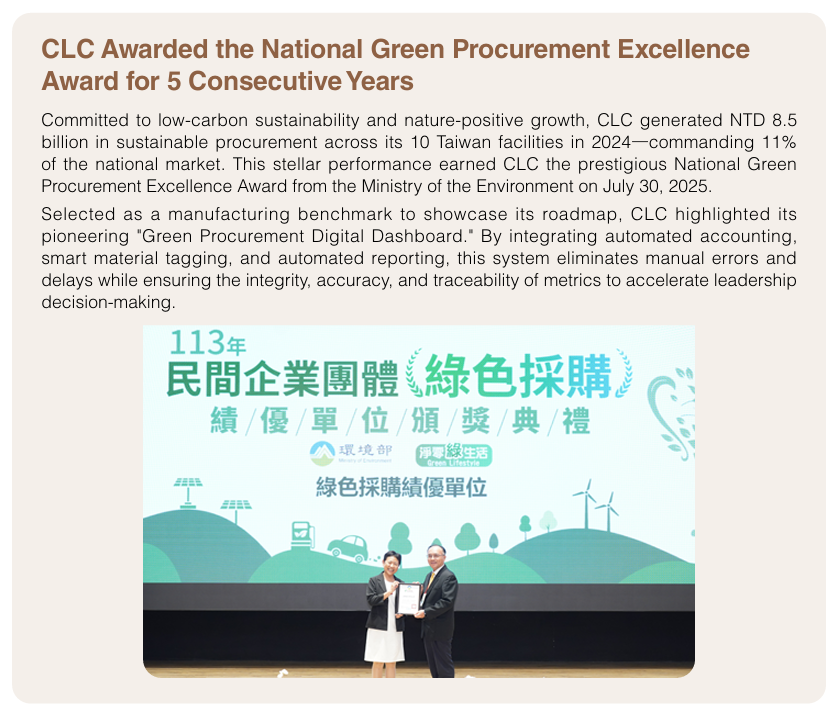
CLC has implemented green procurement to support SDG 12, prioritizing materials, facilities, and office supplies with environmental, energy-saving, and FSCTM certifications to reduce environmental impact and enhance resource efficiency, thereby strengthening supply chain sustainability and resilience.
In recent years, the international community has placed increasing emphasis on the loss of natural capital and promoted the "Nature Positive" approach to reverse biodiversity loss and foster harmony between economic development and sustainability. CLC set a 2030 target for > 98% FSCTM pulp procurement in line with SDG 15. In 2025, FSC™-certified pulp accounted for 95.3% of CLC’s virgin pulp procurement, below annual target due to global supply constraints and price fluctuations. CLC sourced local alternatives in Taiwan to maintain stable production and meet its environmental commitments.

❙ Conflict Minerals Prohibition
To uphold human rights, CLC avoids the use of conflict minerals sourced from illegal or unethical operations and remains committed to responsible mineral sourcing throughout its supply chain. We prohibit the use of tin, tantalum, tungsten, and gold from the Democratic Republic of the Congo and neighboring regions in the production of industrial paper and corrugated containers. CLC requires suppliers to conduct due diligence on mineral sourcing and address risks of human rights violations and environmental harm. CLC maintains conflict-free sourcing, monitors international mineral management requirements, and communicates with its supply chain.
❙ Prohibited Substances
CLC established the Hazardous Substance Inspection Management Measures to ensure compliance with international regulations. Since 2021, CLC has implemented full material declaration (FMD) management, requiring suppliers to regularly submit hazardous substance verification reports and declarations. All raw materials, finished products, and new materials must comply with prohibited substance controls.
Advancing Recycling Supply Chain Transformation: Cross-sector Collaboration for Source-controlled, High-performance Recycling
❙ Enhancing Source Separation for Increased Corporate Recycling Efficiency
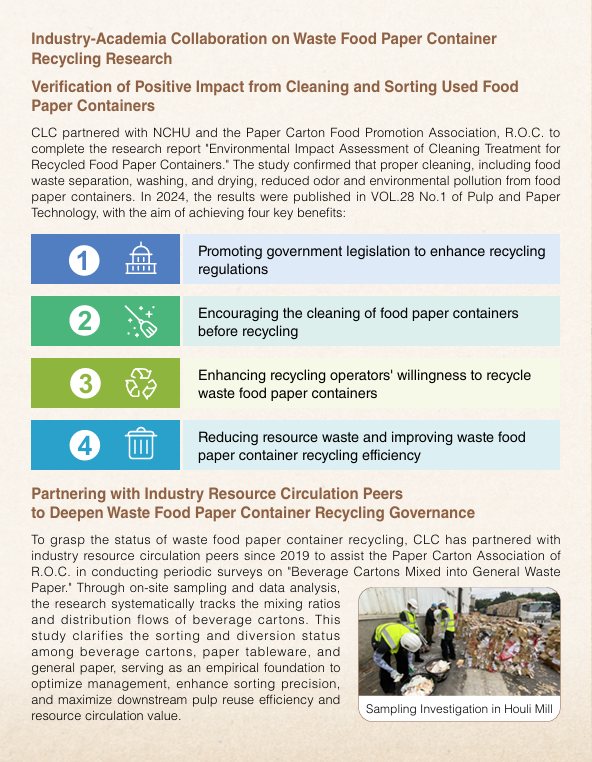
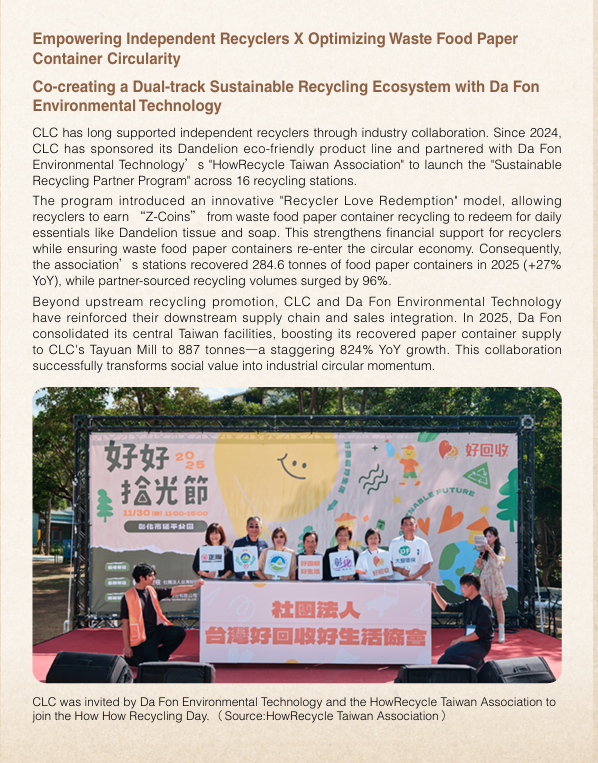
As the largest recovered paper processor in Taiwan, CLC has made circular economy a core strategy. In response to the long-standing issue of 10~13% domestic waste contamination in locally collected recovered paper which compromises recycling efficiency and increases energy consumption during processing, CLC has, since 2018, assisted 167 recycling partners to improve recovered paper quality and meet international standards. In 2024, CLC launched the Food Paper Container 2.0 Project, training key regional partners and supporting 56 suppliers to optimize food paper container sorting and processing, enhancing the local recovered paper supply chain.
❙ Recycling Supply Chain Upgrade: Paper Sludge Reduced by 40%
Since 2018, CLC has set an annual target to support the transformation of at least 2 recovered paper merchants and revised its recovered paper procurement policy. We have also introduced Taiwan's first Recovered Paper Moisture Analyzer and established an e-platform. For 167 recovered paper merchants, CLC implemented a three-stage process— guidance, observation, and replacement—emphasizing source classification and technical support. By 2025, CLC assisted 16 key merchants in transformation, achieving a nearly 40% reduction in paper sludge compared to 2017 through process innovation, and enhanced recycling and energy efficiency.