Circular Economy
循環經濟

CLC: New Low-Carbon & Green Energy Paper Company
Paper, the daily necessity tied up in our lives, is also an indispensable part of industrial and commercial packaging.
“Cherish Resources and Create a Secondary Forest.” Since the establishment of CLC in 1959, we have made good use of paper's cycle characteristics to reproduce various paper products made out of recovered paper using green paper production. The paper, or industrial paper to be more specific, is the greenest and most sustainable packaging material since it is reused, recycled, and renewed on a continuous basis. Moreover, the paper industry is also a typical and important circular economy industry.
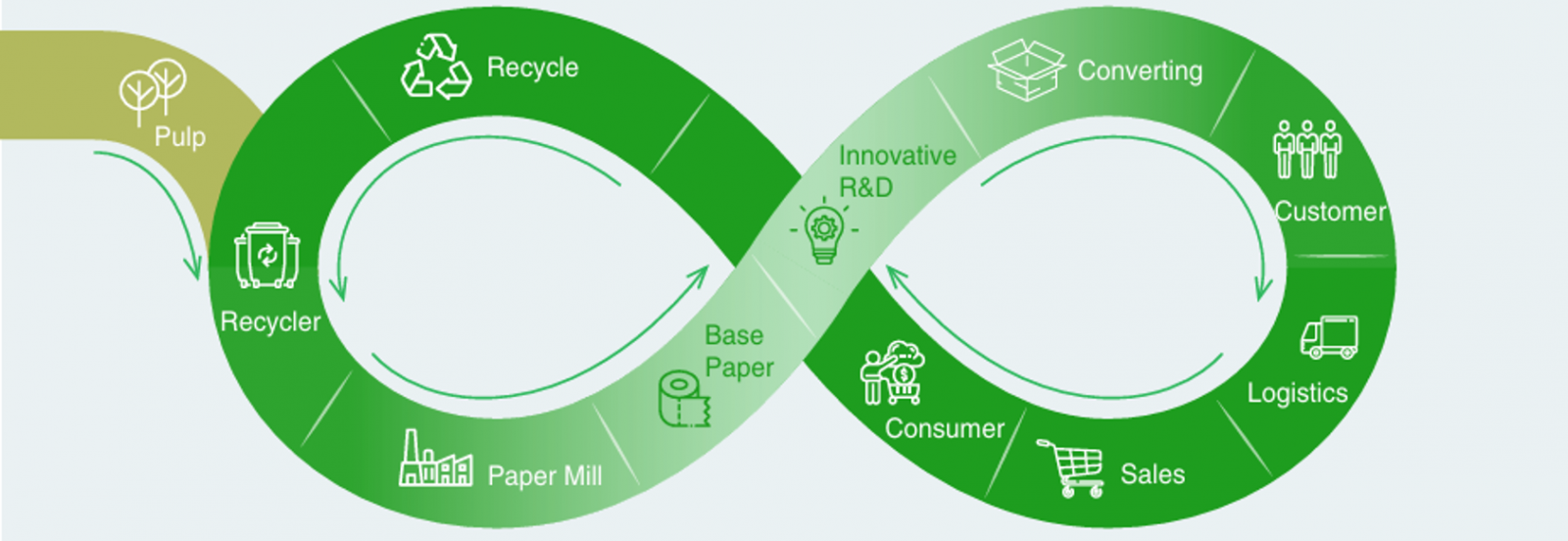
The life circle of CLC's products starts from the use of raw materials and then comes to R&D and design, green production, logistics and distribution, and then the end-consumer. Through the operational mode with papermaking and paper converting as the core, we provide a variety of products and comprehensive solutions for paper packaging to serve clients around the world. Meanwhile, we introduce advanced automatic equipment to improve the production and expand our green low-carbon production sites continuously, so as to strengthen the operational capacity and maintain our leading role in the market. CLC is currently the largest manufacturer of industrial paper products and paper containers as well as one of the largest paper companies in Asia.
To accomplish the vision of zero waste, CLC makes efforts to recycle the process residual material, promote the alternative fuel, and develop green energy via cross-industry cooperation, in order to actively transform ourselves into a new low-carbon green energy paper industry for the 21st century.
Secondary Forest.Circular Economy
For a product life circle which refers to phases of material use, product design, green manufacturing, logistics and distribution, and the end-consumer, we adopt a circular economy model of “renewable resource - paper making - packaging” to research and develop innovative and diverse green products and services, aiming at creating the circular benefits of secondary forests. In recent years, we have been actively integrating the total circulation of three major resources: products, energy, and water through the low-carbon S.M.A.R.T. paper strategies: Subtraction-reducing resource consumption use, Materials-turning waste to energy, AI-smart production-sales, Recycling-reusing recovered paper, and Technologies-advanced processes to transform traditional factories into eco-friendlier smart and recycling plants.
As an industry leader focused on nature-based solutions, CLC is committed to a circular business model that balances environmental friendliness with market demand. By optimizing processes, adopting advanced eco-equipment, and implementing smart production and sales management, CLC maximizes paper recycling, enhances product quality, and cuts carbon emissions to drive a low-carbon transition for the paper industry.
In 2025, CLC's Taiwan Parent Company utilized 1.564 million tonnes of recovered paper, achieving an overall utilization rate of 94.5% and reaching 97.6% for industrial paper (exceeding the 97% target). The Vietnam Binh Duong Mill used 721,000 tonnes, with its industrial paper utilization rate reaching 95.7%, surpassing the 94% target. Overall, CLC utilized 2.285 million tonnes of recovered paper groupwide, which preserving 45.7 million trees(Note) and expanding the sustainable impact of "secondary forests."
*Note: Based on international estimating standards, 1 tonne of recovered paper pulp is roughly equivalent to saving 20 trees (actual values vary depending on paper types and manufacturing processes)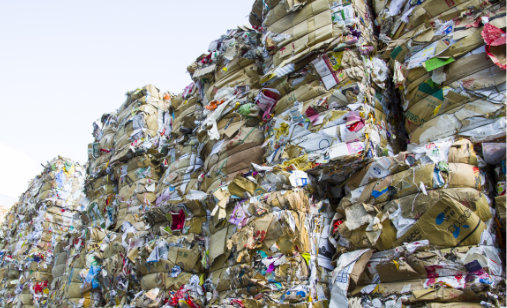
Note 2: Based on CLC production data, recycling 1 tonneof recovered paper contributes to 5.8 tCO2e in carbon reduction, which is equivalent to preserving approx. 20 trees under international estimation standards.
Note 3: The benchmark for one Daan Forest Park is defined as 6,000 trees.
Green Production.Save Energy and Reduce Carbon Emission
Upholding our energy policy of “Total Participation, Energy Saving & Carbon Reduction, and Green Manufacturing,” CLC has fully implemented the ISO 50001 energy management system. Integrating digital monitoring and analytical tools, we have established a real-time, data-driven mechanism, to track performance and drive continuous improvements, ensuring energy-saving targets are effectively met. In response to the Energy Administration’s (MOEA) initiative to raise the annual energy-saving target for major electricity consumers to 1.5% under the national net-zero roadmap, CLC has integrated this goal into its annual management indicators. Our Taiwan mills/plants propose concrete energy-saving plans each year, continuously enhancing energy efficiency and carbon reduction. Key measures include optimizing high-efficiency cogeneration systems, installing renewable energy equipment, improving process performance, and implementing intelligent energy management platforms. Combining institutionalized management with digital empowerment, CLC is steadily advancing its transformation blueprint toward a “Low-carbon & Green Energy Paper Industry”.
.jpg)
Innovative Circular Economy
First Paper Maker Completely Recycling Waste Food Paper Containers
Implement the Total Circular Resource to Respond to the Plastic-Reduction Policy
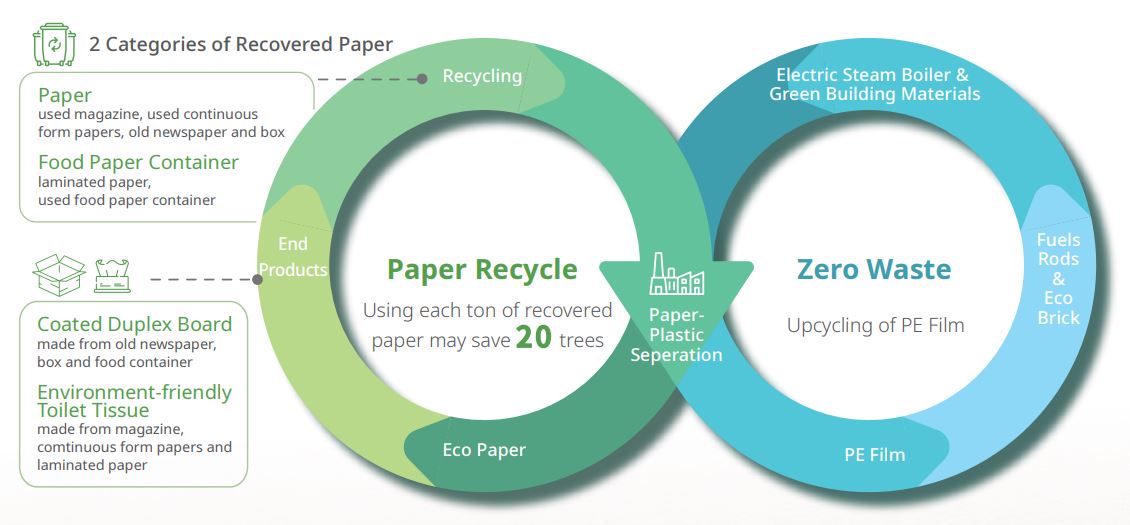
In response to over 8 billion of waste food paper containers discarded annually in Taiwan, CLC has established the world's largest integrated solutions for food paper container recycling. Through innovative process technology, we have achieved high-efficiency paper-plastic separation, converting recovered containers into recovered bleached pulpline. Simultaneously, the surface PE (Polyethylene) lamination is repurposed into green fuel. This breakthrough in circular economy applications creates high-value-added green business opportunities that replace imports and significantly reduce carbon footprints.
Breaking the “Food Paper Container Waste Dilemma” through Circularity and Building a Sustainable Value Chain
While food paper containers, which require paper-plastic separation at professional factories, are designated as mandatory recyclable items by the Ministry of Environment. However, the lack of public awareness and specialized recycling capacity often leads to improper disposal and resource waste. Committed to resource regeneration, CLC has invested in innovative circular applications for food paper containers since 2018. At Chupei Mill, we established Taiwan’s 1st total integrated recycling line for food paper containers. By implementing advanced paper-plastic separation technology, we transform waste food containers into industrial coated cardstock, while clean trimmings are recycled into eco tissue. The remaining impurities and plastic coatings are processed into green energy fuel or eco-friendly building materials, establishing a sustainable business model that achieves both waste reduction and value creation.
Scaling up! Making the waste food paper containers to low-carbon products
To continuously scale our recycling capacity, CLC invested NTD 1.5 billion in 2023 to add a 66,000-tpa Recovered Bleached Pulpline at our Tayuan Mill. This expansion brings the Group’s total processing capacity for waste paper containers to 176,000 tpa, ranking among the top globally. This infrastructure allows us to process over 50% of Taiwan’s waste paper containers, contributing to an indirect carbon reduction of 1.02 million CO2e while reducing our reliance on imported virgin pulp and natural resources.
Furthermore, CLC has spearheaded the "Recycling Supply Chain Transformation and Upgrade" initiative. We collaborated with recycling operators to build Taiwan’s 1st dedicated recovery system for paper meal boxes. Through equipment upgrades, standardized sorting protocols, and on-site guidance, we have helped 167 recycling suppliers improve quality at the source, reducing paper residue by nearly 40% (compared to the base year 2017). To date, our network of partner recyclers has grown to 56 companies, a 56-fold increase since 2018.
Deepening Environmental Awareness: Sustainable Teacher Training Workshops Rooting Sustainability in Education
As our circular ecosystem matures, we are extending its value to education and the community. In 2021, CLC partnered with Tetra Pak and the Future Parenting Learning Platform to launch the "Sustainable Cycle of Paper" curriculum. This initiative provides free resources, including picture books, animations, and card games, to schools and community libraries. Our "Sustainable Teacher Workshops" have successfully integrated recycling knowledge into grassroots education, impacting over 27,000 children.
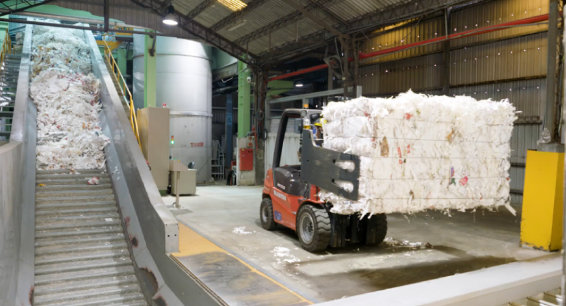
CLC Document Destruction Technologies Enable Recycling: Cutting 91,715 tCO2e & Preserving 316,000 Trees
Since 2013, CLC has utilized existing pulp dispersion equipment to provide free confidential document destruction services. Over several years, CLC assisted nearly 400 partners—including government agencies, listed companies, financial and insurance firms, and defense units—by converting 15,813 tonnes of confidential documents into various recycled paper products, driving all-around benefits.
(For more details, please refer to the Document Destruction Service)
Sustainable Economic Activities
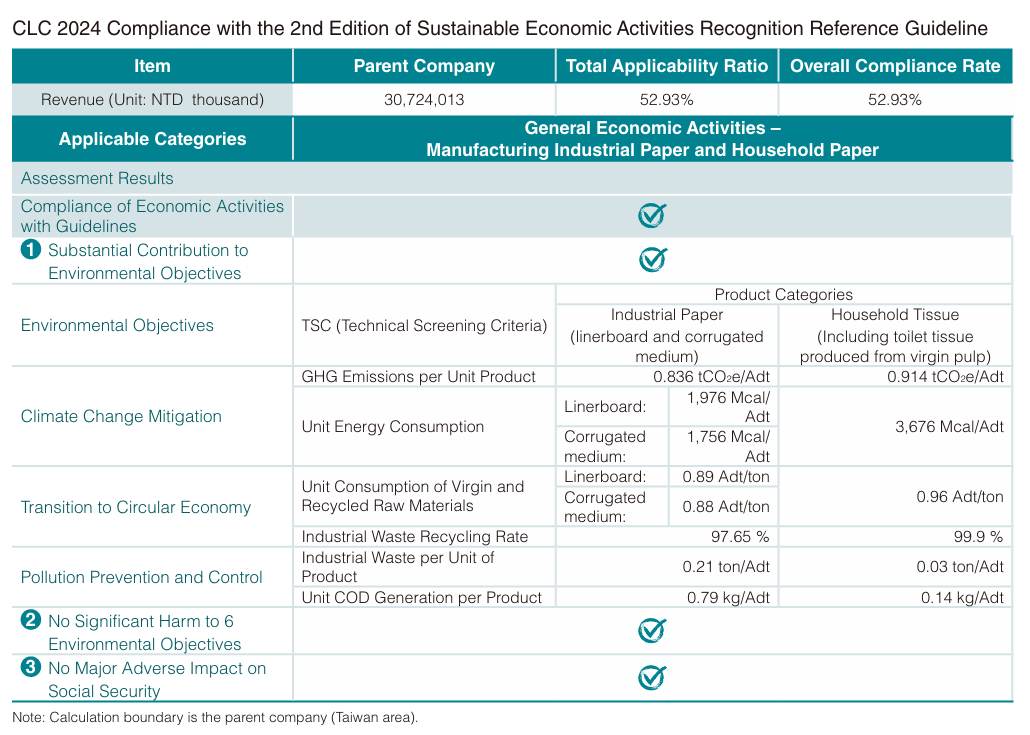
CLC adopts a resource circular business model centered on low-carbon paper, paperboard, and carton manufacturing, processing, and services. Green products account for over 95% of revenue, providing diverse eco-friendly paper solutions to the market.
According to the Taiwan Sustainable Economic Activities Recognition Reference Guideline (2nd Edition), CLC produced paper and paperboard through a circular economy model, meeting the criteria under the General Economic Activities category. In 2024, CLC reported revenue of NTD 30.72 billion in Taiwan, with 52.93% both applicable to and compliant with sustainable economic activities. This covered the production of low-carbon industrial paper (linerboard and corrugated medium) and household paper (including toilet tissue made from virgin pulp). All activities met 3criteria: substantial contribution to at least one environmental objective, no significant harm to any of the 6 environmental objectives—climate change mitigation, climate change adaptation, sustainable use and protection of water and marine resources, transition to circular economy, pollution prevention and control, and protection and restoration of biodiversity—and no significant harm to social safeguards.